
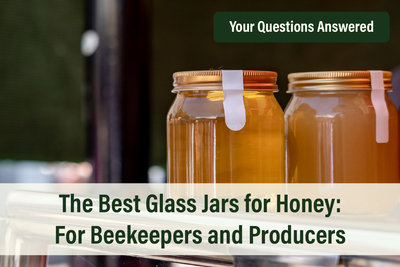
The Best Glass Jars for Honey: For Beekeepers and Producers
Posted by The Wares Team on 8th Oct 2026
Quick answer: The best honey jar is the one that fits your declared net weight, label and sales channel without adding unnecessary packing cost. A 353ml 1lb round jar is a dependable core format; 190ml and 280ml hexagonal jars work well when a smaller pack or more distinctive presentation is part of the range.
Shop the relevant range Honey jar range | Wholesale honey jars | Honey jar labels
Start With the Sales Channel
| Sales channel | What matters most | Useful jar approach |
|---|---|---|
| Farmers markets | Clear pricing, easy handling and visual distinction | One core size plus one smaller gift or trial size |
| Farm shops and delis | Shelf presence, tamper evidence and reliable replenishment | Standardise the jar, lid and label across batches |
| Online orders | Leak resistance, parcel weight and protective packaging | Test the complete packed parcel before launch |
| Gift sets | Compact sizes and consistent presentation | Use smaller jars that fit a repeatable box or tray |
| Wholesale supply | Unit cost, case quantities and stock continuity | Limit the range to formats you can reorder at scale |
Choose a Shape That Works With the Label
Round jars suit wraparound labels and provide a familiar honey-jar profile. Hexagonal jars offer flat faces for a front label, back label or batch sticker. Before ordering, print the label at full size and apply it to a sample jar. A label that looks balanced on screen can crowd the shoulders, bridge a facet or sit too close to the base once applied.
Use the Correct Closure
Honey is usually filled at room temperature or gently warmed for flow rather than hot-filled like jam. The twist-off lid still protects it from dust, moisture and contamination, but the vacuum may be less pronounced. If you use a button lid, do not treat a strongly depressed button as the only sign of a sound closure.
Match the lid to the exact jar finish and follow the supplier's application instructions. The 280ml hexagonal honey jar uses a 63mm lid, while the 353ml 1lb honey jar uses a 70mm lid. A shared lid colour can unify different jar shapes across the range.

Plan the Label Before Production
Build the label around the actual legal name, net quantity, origin information, business details, lot or date coding and any other information required for the market in which the honey is sold. Honey has product-specific labelling rules, so check current official guidance rather than relying on a competitor's label as a template.
Leave enough clean glass for the product to remain visible. Batch codes and best-before information also need a consistent position that production staff can apply accurately.
Consider Tamper Evidence and Transport
A shrink band or other tamper-evident feature can provide additional reassurance when jars are sold through a third party. For ecommerce, test the jar, lid and outer packaging together. Check for leakage, lid scuffing, label abrasion and glass-to-glass contact after the parcel has been handled in different orientations.
Standardise Before You Scale
Using one or two jar sizes simplifies label ordering, case packing, stock counts and reordering. It also reduces the chance of running out of one component while holding surplus stock of another. We list retail, boxed and pallet quantities across the honey range, and larger producers can request a quote for the combination they need.
- Calculate the filled cost, including jar, lid, label, tamper evidence and outer packaging.
- Check case and pallet quantities against realistic production volumes.
- Keep a buffer of compatible lids so a run is not delayed by a small shortage.
- Record the product code and lid specification in the production sheet.
- Recheck dimensions and availability before changing labels or ordering packaging in volume.
