
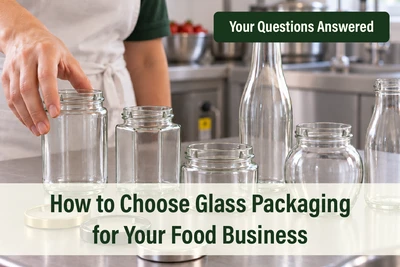
How to Choose Glass Packaging for Your Food Business
Posted by The Wares Team on 6th Oct 2026
Quick answer: Choose the jar, lid, label and outer packaging as one system. Start with the product's filling and processing requirements, then compare usable label area, filled cost, sales channel, pack quantities and transport performance. Test samples before ordering production volumes.
Shop the relevant range Wholesale glass | Request a wholesale quote | Labels and tags | Jar and bottle packaging
Start With the Product and Process
The product determines the technical requirements. Record its texture, acidity, filling temperature, processing method, target shelf life and how it will be served. Confirm that the jar and closure are suitable for those conditions before discussing colour or shape.
| Product | Packaging priorities | Useful starting point |
|---|---|---|
| Jam and marmalade | Compatible heat-sealable lid, recipe headspace and spoon access | 228ml or 370ml jam jar |
| Honey | Declared net weight, moisture protection and label presentation | 190ml, 280ml or 353ml dedicated honey jar |
| Chutney and relish | Vinegar-resistant lid and access for textured food | 190ml to 500ml food jar |
| Pickles | Wide opening, suitable process and room for larger pieces | 480ml or larger pickle jar where the recipe permits |
| Sauces | Controlled serving, hot-fill compatibility where required and shipping performance | Jar or bottle matched to product viscosity |
Choose the Capacity Around Price and Usage
A smaller jar lowers the shelf price but usually increases packaging cost per gram. A larger jar can improve value perception but raises the purchase price and parcel weight. Model at least two sizes using the actual filled cost, expected selling price and how quickly customers use the product after opening.
A single core size is often the simplest launch option. Add a smaller gift or trial format only when it serves a clear customer need and the extra labels, stock and production changeovers are justified.
Calculate the Complete Filled Cost
- Glass jar or bottle and the compatible closure.
- Label, batch coding and any tamper-evident component.
- Ingredients, filling loss and labour.
- Dividers, trays, cases, gift boxes or postal packaging.
- Inbound delivery, storage space, breakage allowance and outbound shipping.
Compare the cost per saleable unit, not only the jar price. A cheaper jar can become more expensive if it needs a bespoke label, heavier parcel or more protective packaging.
Check the Lid as Carefully as the Glass
Confirm the exact neck finish, lid size, sealing compound and whether a standard or button lid suits the process. Acidic foods need an appropriate lining. Products that depend on heat processing need a closure approved for that method. Honey may use the same twist-off format but does not normally create the same vacuum as a hot-filled preserve.
Design the Label on a Filled Sample
Measure the usable label panel, not the widest part of the jar. Shoulders, curves, facets, embossing and the fill line all affect the finished appearance. Apply a full-size label to a filled and closed sample, then photograph it under the lighting used for the website and product listings.
Check current legal requirements for the place and method of sale. Depending on the product, these can cover the food name, ingredients, emphasised allergens, net quantity, date marking, storage instructions, responsible business details, nutrition information, origin and lot identification. Honey also has product-specific rules. Official guidance should be reviewed before labels are printed in volume.
Or contact Wares about our glass printing service.
Official guidance Packaging and labelling requirements for food businesses

Match the Packaging to the Sales Channel
|
Channel |
Questions to answer before ordering |
|---|---|
|
Markets and events |
Can staff transport, display and price the range efficiently? |
|
Independent retail |
Does the case quantity match likely sell-through, and is tamper evidence appropriate? |
|
Ecommerce |
Has the complete parcel passed leakage, impact and orientation tests? |
|
Wholesale |
Can you maintain the same jar, lid, label and case specification across repeat orders? |
|
Gifting |
Does the jar fit the selected box, tray or hamper without custom packing waste? |
Order Samples Before Production Quantities
A sample run should use the real product and process. Fill, close, cool, label, code, pack and transport the jars exactly as planned. Check the seal, fill line, net quantity, label adhesion, opening experience and pack-out time. If the product will be posted, send test parcels through the intended delivery network rather than relying on a bench-top drop test alone.
Plan for Wholesale and Growth
We lists retail, wholesale boxed and pallet quantities across much of the range, with quote options for larger requirements. Before moving to a pallet, compare usage rate with storage capacity and cash flow.
We offer the option of mixed pallets allowing customers to pick different products and build a pallet and in doing so, receive the wholesale price. This is subject to a minimum number of boxes on the pallet.
- Keep the current product code, dimensions, lid size and supplier in a packaging specification sheet.
- Set a reorder point that covers production lead time and seasonal demand.
- Hold a sensible buffer of lids and labels, which can stop a run even when glass is available.
- Approve any substitution against the filled sample and process, not capacity alone.
- Recheck live specifications before each large order because ranges and pack quantities can change.
Final Packaging Checklist
- The jar is suitable for the product and filling or processing method.
- The lid is compatible, correctly lined and available in the required quantity.
- The filled unit meets the intended net quantity and looks balanced at the chosen fill line.
- The complete label fits the usable panel and has been checked against current requirements.
- The unit and outer packaging have been tested for the intended sales channel.
- Case quantities, pallet quantities, storage and reorder timing support the production plan.
Making these decisions together prevents a common packaging problem: choosing an attractive jar first, then discovering that the lid, label, process or shipping cost does not suit the product. A tested packaging system is easier to price, order and repeat as the business grows.
